Breach of Contract
What is Breach of Contract?
A breach of contract happens when there’s an agreement and one side doesn’t do what they promised. Common examples:
- A contractor agrees to fix your shed but never shows up.
- An insurance company refuses to pay a covered claim under your policy.
- A company won’t honor its written warranty.
In law, a “contract” means an agreement. Many valid contracts are verbal; they don’t have to be in writing unless a specific statute requires it.

What do you need to have a case?
Valid Contract
A valid contract usually requires three things: offer, acceptance, and consideration (each side gives or promises something of value).
Breach
The other party failed to perform a required duty (missed deadlines, delivered the wrong thing, refused to pay, etc.).
Damages
You must have suffered a measurable loss due to the breach.
Example: You agreed to see a TV for $200.
- If the buyer took the TV, paid by check, and the check bounced, you're out $200 -- that's damages.
- If the buyer never showed up but another buyer immediately pays the same $200, you may not have any damages.
How Much Can You Recover?
- Expectation damages: Often the amount needed to put you in the position you would have been in if the contract was honored (e.g., the $200 for the TV, or the cost to repair work a contractor failed to do).
- Consequential damages: Sometimes recoverable if they were reasonably foreseeable (e.g., extra costs caused by delays), subject to state law and contract terms.
- Attorney’s fees and interest: Only if the contract or a statute allows it.
- Insurance bad faith (special case): If an insurer denies a claim without a reasonable basis, you may be able to seek additional “bad faith” damages beyond the unpaid benefits, depending on your state’s laws.
No lawyer can guarantee a result. We evaluate the contract, the breach, your documentation, and applicable law before estimating value.
It's probably okay if your contract isn't in writing
Most contracts don’t need to be in writing in Ohio, Kentucky, or Indiana (or any other state for that matter).
If your contract is in writing, make sure you have a copy of it.
If you are suing based on a written contract, make sure you keep a copy of the contract. In Ohio, if you sue someone based on a written contract, you have to attach the written contract to the complaint. If you have already lost the contract, tell your lawyer. She might be able to find a workaround.
You Have to Sue Before the Statute of Limitations Expires.
Time limits vary by state and by whether the contract is written or oral. As a general example, many Ohio written-contract claims have up to ten years. Other states and certain claim types can be much shorter. The safest move is to speak with a lawyer promptly so you don’t miss your deadline.
Practical Tips If You’re Considering a Breach of Contract Claim
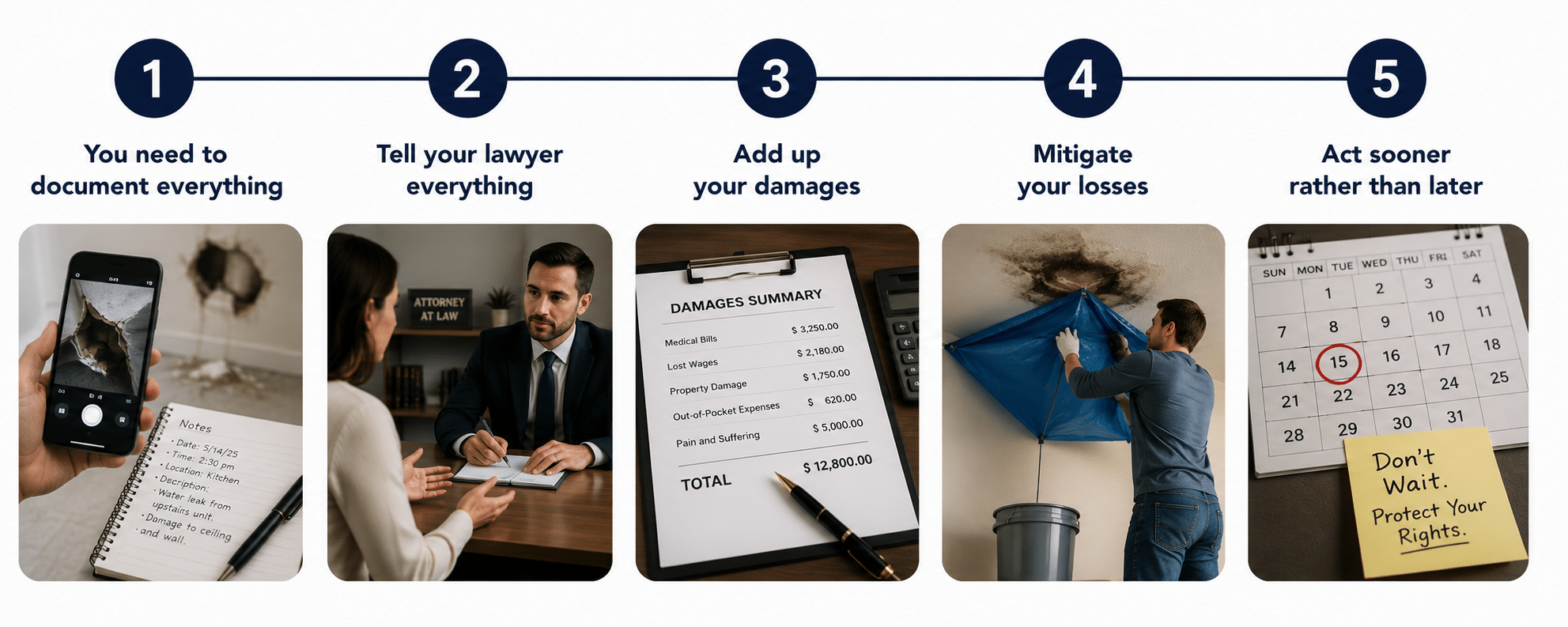
Document everything
- Save the contract (if written), emails, letters, texts, change orders, invoices, checks, and call logs.
- Keep a dated timeline of promises made, work performed (or not), and costs you incurred.
Tell your lawyer everything.
- Share all facts, even the ones -- ESPECIALLY the ones -- your case. Surprises help the other side, not you.
Add up your damages
- Keep lists of how much money you are out of pocket: payments made, sales lost, repair or replacement costs, late fees, lost income, etc. Keep receipts and estimates.
Mitigate your losses
- Generally, you must take reasonable steps to reduce your damages (like hiring a different contractor at a fair price). Track your efforts and costs.
Act sooner rather than later
- Early legal advice can preserve evidence, manage communications, and keep you within your statute of limitations.
If this is an insurance dispute, save your policy, declarations page, denial letters, and claim notes.
When We Are a Good Fit
- Disputes with contractors, vendors, or service providers
- Warranty and merchandise failures
- Insurance benefit denials and coverage disputes
- Business-to-business agreements gone sideways
We assess your agreement, identify breaches, calculate damages, and pursue negotiation, mediation, arbitration, or litigation as appropriate.
How Much Money Can You Win if You Sue for Breach of Contract?
It depends. Often, you can win the amount of money you lost because the other person breached the contract. Let’s take the example discussed earlier. If you have an agreement with someone to buy your TV for $200, and that person takes the TV, gives you a check, and the check bounces, you can win $200.
If you have to sue your insurance carrier, things might be different. If the insurance carrier is supposed to pay for repairs for your car if you are in an accident and they don’t pay you, you might just be able to win the amount of the repairs. But you might be able to win more. If the insurance carrier had “no reasonable justification” for denying your claim, you might be able to get “bad faith” damages from your insurance company – that is basically a fine they have to pay to you for breaching their contract with you in bad faith.

Conclusion about Breach of Contract
Usually, contracts do not need to be in writing, and you can sue someone for breach of contract even if the contract is just a verbal agreement. If you do have a written contract make sure you hold onto it. Also hold on to all the writings you have, including all emails and all letters. If you are thinking about suing someone for breach of contract, contact a lawyer soon rather than later, and tell the lawyer everything that could be relevant to your breach of contract case.
You might just be able to win the amount of money you are out because the other person breached the contract. However, in some cases, you can win more money than that.

Legal Notice: This page is for general information only. It is not legal advice. Results depend on the facts and laws of your jurisdiction. If you have questions about your specific case, please contact Beck Law Center at 888-434-2912.
A note regarding images: Images on this website are for illustrative purposes only. Some images are originals; some are stock photos; some have been modified or created using AI.