Traditional Assault
What do we mean by "traditional assault"
We use “traditional assault” to describe assault cases that aren’t domestic violence or bullying. Regardless of the label, if someone intentionally harms you (or intentionally commits a wrongful act that causes you harm), you may have a civil claim.
Note: Legal terms vary by state. In many states, “assault” can mean a threatened or attempted harmful contact, while “battery” is the actual unwanted physical contact. For simplicity, we use “assault” on this page for physical harm claims.
What Counts as a "Traditional Assault"?
- Intentional harmful contact
- If someone sets out to hurt you and causes physical injury, that’s actionable.
- Intentional wrongful act that causes injury (even if the exact injury wasn’t intended)
- Example: A hotel guest intentionally places a squeaky toy in a walkway as a “prank.” You step on it, fall, and break your arm. They didn’t intend your injury, but they did intentionally do the wrongful act that led to it.
- That can support a civil claim for your injuries.
- Depending on state law, this may be pursued as battery, negligence, or both. You don’t have to prove the person intended the precise harm—only that their intentional act or wrongful conduct caused it.
- No physical contact still can count in some states
- In some jurisdictions, a credible threat or attempt that causes reasonable fear of imminent harm may constitute assault. If you were injured while escaping or reacting, you may have additional claims.
Can I Sue for Assault if I Don't Know that Name of the Person Who Committed the Assault?
- If the assailant was an employee acting within the scope of their job (e.g., a bar bouncer), you can often sue the business (vicarious liability/respondeat superior). The business may be responsible for the employee’s wrongful conduct.
- If the person wasn’t an employee, you may still have a claim against the business for negligent security or failure to protect customers if:
- The risk of violence was reasonably foreseeable (e.g., prior incidents, inadequate lighting, broken door locks, ignored warnings),
- The business failed to take reasonable measures to prevent or stop it.
- Businesses generally must take reasonable steps to address an obvious, ongoing fight on their premises.
Evidence like incident reports, prior police calls, surveillance footage, and witness statements can be critical in these cases.
What you can recover in a civil assault case?
Depending on your state and facts:
- Medical bills and future treatment
- Lost wages and reduced earning capacity
- Pain, suffering, and emotional distress
- Property damage and other out-of-pocket costs Punitive damages may be available in some intentional misconduct cases, subject to state law.
What to do right now
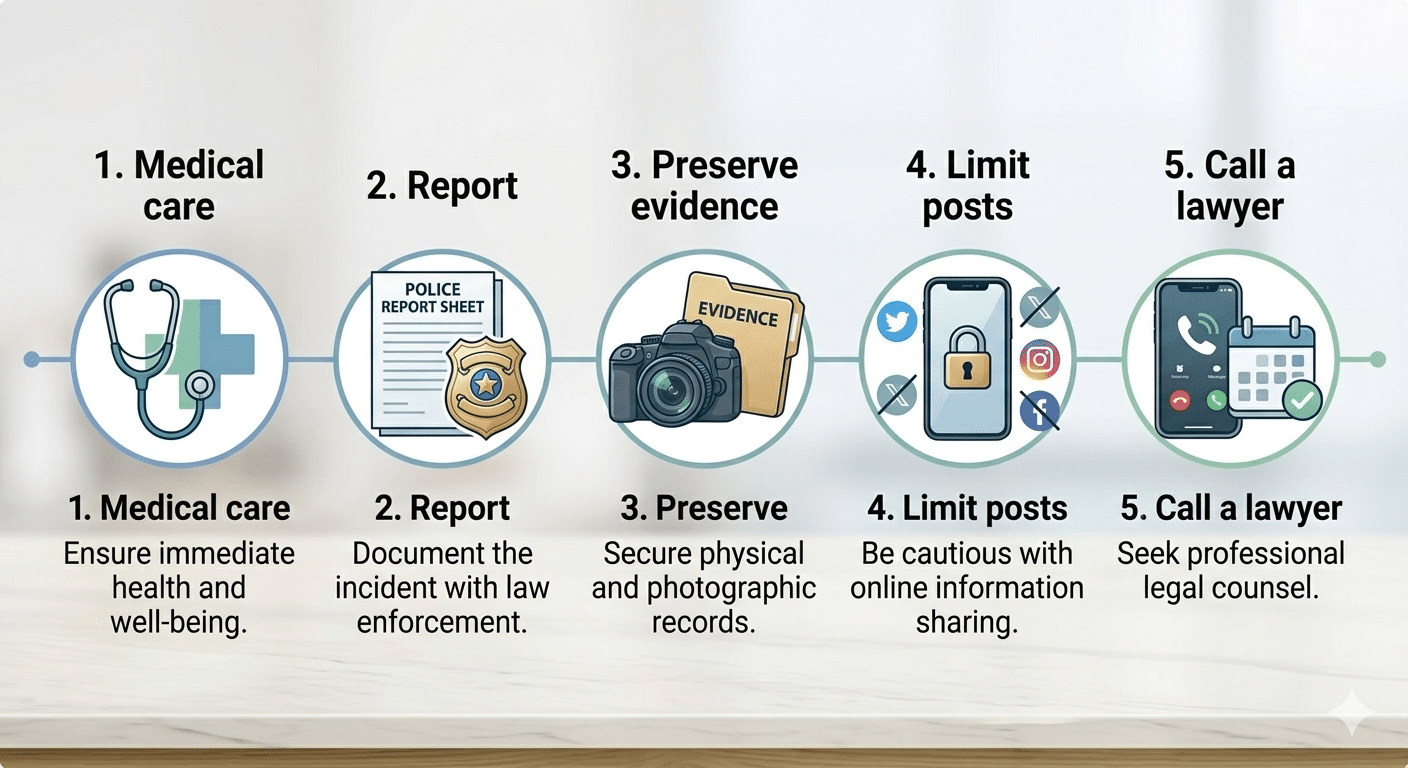
Get medical care
- Your health comes first. Obtain treatment and keep copies of all reports.
Report it
- File a police report as soon as possible. Ask for the report number.
Preserve evidence
- Take photos of the injuries and the scene
- Make sure you get the names and contact information from all the witnesses, if possible.
- Ask for surveillance video as soon as possible. Surveillance video often gets deleted within a day or a week of the recording.
- Keep any damaged property.
Limit public posts
- Avoid social media posts about the incident or your injuries.
Talk to a lawyer promptly
Call us at 888-434-2912.

How Beck Law Center helps
- Investigate and gather evidence (including premises/security issues)
- Identify all responsible parties (individuals, employers, property owners, security contractors)
- Coordinate medical documentation and valuate your claim
- Negotiate firmly and litigate when needed
Click the photos below for more information about assault/bullying.


Legal Notice: This page is for general information only. It is not legal advice. Results depend on the facts and laws of your jurisdiction. If you have questions about your specific case, please contact Beck Law Center at 888-434-2912.
A note regarding images: Images on this website are for illustrative purposes only. Some images are originals; some are stock photos; some have been modified or created using AI.